Rodent control in Philadelphia demands architectural literacy due to the dense arrangement of historic brick rowhouses and shared party walls found throughout Fishtown, South Philadelphia, and Passyunk Square. A single…
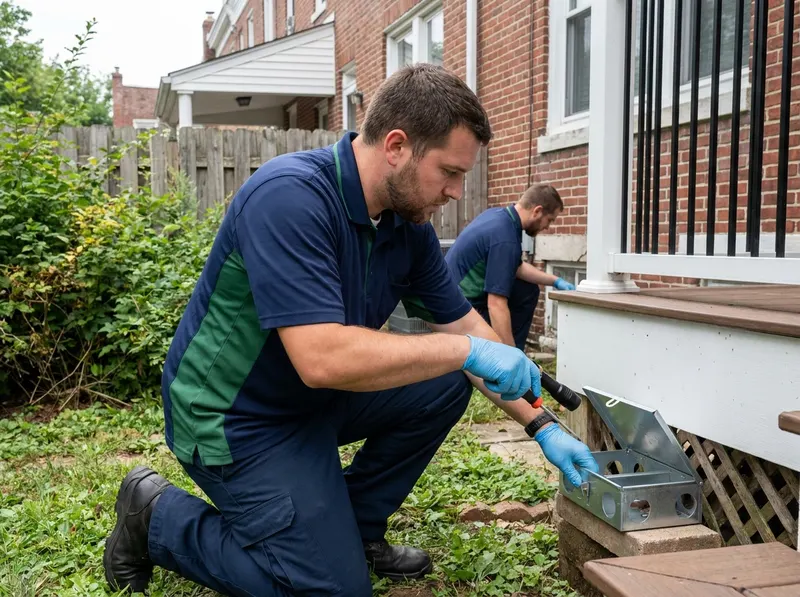
Rodent control in Philadelphia demands architectural literacy due to the dense arrangement of historic brick rowhouses and shared party walls found throughout Fishtown, South Philadelphia, and Passyunk Square. A single shared subfloor or roofline breach permits Norway rats (Rattus norvegicus) and house mice (Mus musculus) to forage across an entire block. Mice require an opening of merely 0.25 inches, the diameter of a standard pencil, to breach an exterior envelope, according to the CDC Rodent Prevention Guidelines. Crestora Pest Defense addresses these structural vulnerabilities by applying high-density copper mesh, silicone sealants, and 16-gauge galvanized steel hardware cloth to utility penetrations, stone foundation gaps, and rotted sill plates. Remediation follows established EPA Integrated Pest Management principles, ensuring indoor containment relies on mechanical capture rather than loose interior rodenticides, which prevents domestic pet exposure and eliminates rodent mortality within wall cavities.
Older residential architecture across Kensington, Manayunk, and University City features fieldstone basements and aging masonry that require rigorous moisture and harborage abatement. In multi-family units, unsealed plumbing chases between floors serve as continuous transit conduits. Standard operating procedure involves inspecting moisture sources regulated by the Philadelphia Department of Public Health, securing crawlspace vents, and installing heavy-duty door sweeps on drafty thresholds. Technicians deploy tamper-resistant, Tier 1 bait stations approved by the EPA Rodenticide Safety Standards along exterior foundation perimeters to interrupt subterranean rat burrows. For properties bordering open green corridors like Wissahickon Valley Park in Chestnut Hill and Mount Airy, exterior rodent activity increases dramatically during late autumn temperature drops, necessitating exterior barrier maintenance under guidelines aligned with the Pennsylvania Department of Agriculture.
Decision guidance hinges on whether a property requires active mechanical trapping, comprehensive structural exclusion, or recurring preventative perimeter monitoring. Trapping alone yields immediate interior population knockdown within 7 to 14 days, but without physical exclusion, external rodents re-infest the structure as soon as ambient scent trails re-establish. Conversely, applying exclusion without prior interior depopulation forces existing rodents deeper into living spaces in search of alternative food sources. Crestora Pest Defense couples lethal interior mechanical traps with exterior exclusion to clear the envelope systematically. Field practices conform to structural pest management standards established by the National Pest Management Association and environmental wildlife handling protocols from the Pennsylvania Game Commission. Commercial properties such as food markets near Reading Terminal Market or retail spaces in Northern Liberties and Rittenhouse Square require ongoing monitoring logs that satisfy FDA HACCP Rodent Standards. Technicians operate using personal protective equipment compliant with OSHA PPE Standards and handle cleaning procedures in line with the HUD Office of Lead Hazard Control and Healthy Homes.
Every job gets a firm, written price after a free on-site visit.
For standards, safe disposal, and service guidance on PEST CONTROL SEVICE in Philadelphia, PA, useful references include U.S. EPA, ENERGY STAR, U.S. Dept. of Energy, Consumer.gov, U.S. Census Bureau, and Google Maps. General consumer and small-business resources are available from USA.gov, Better Business Bureau, FTC Consumer Advice, U.S. Small Business Administration, and Ready.gov.
Tell us about your rodent control job in Philadelphia and we'll send a clear, written quote, usually the same day.
 Crestora Pest Defense